
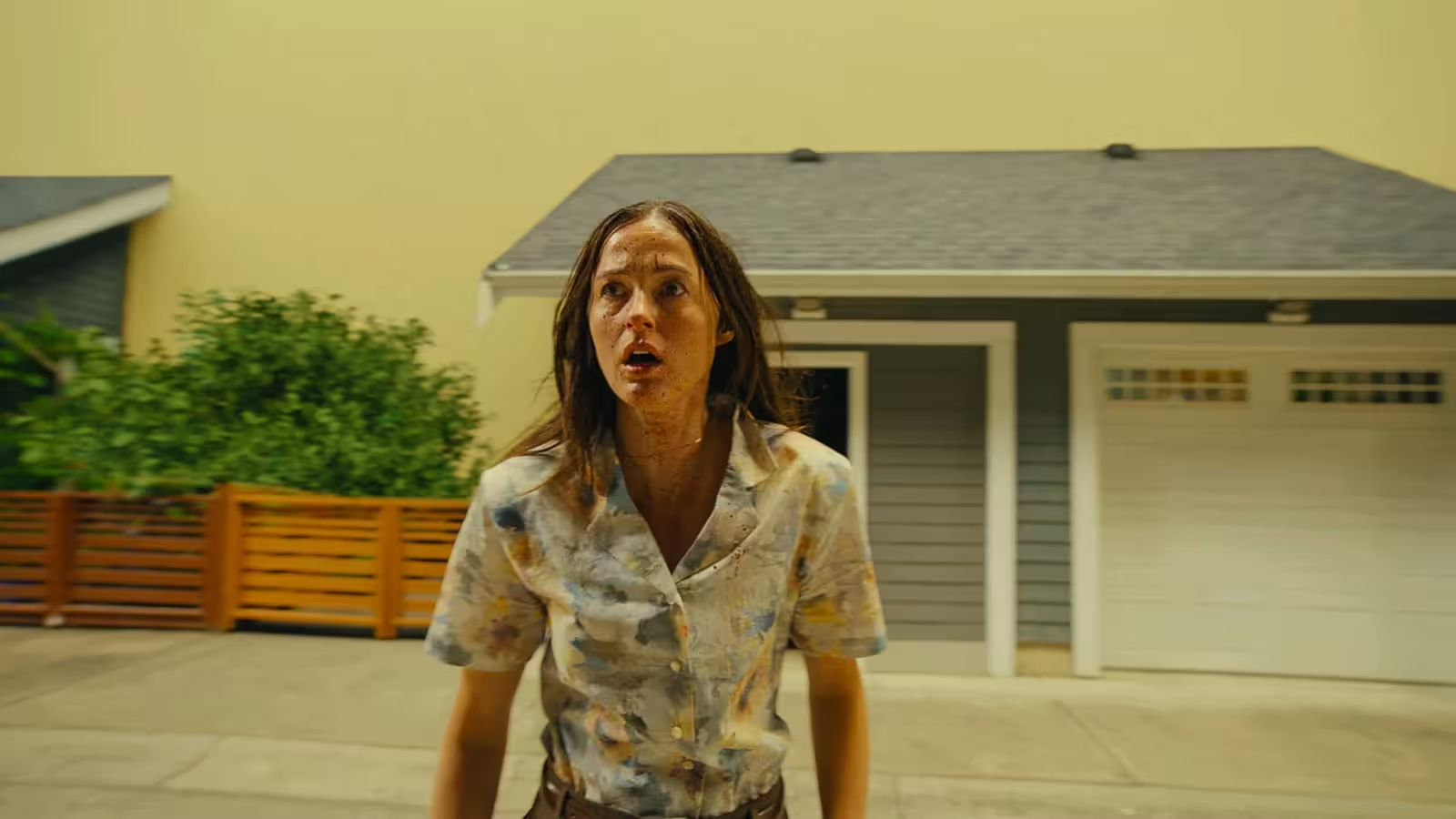
To understand what “Backrooms” is, we first need to understand what backrooms are. So imagine a hallway with carpet and yellow wallpaper that opens into an empty room with the same colors, then into yet another room, and then again and again and again. Something familiar yet out of place, repeating itself. Something familiar yet not fully aligned with our expectations of that place.
Backrooms are the prime and most paradigmatic example of so-called “liminal spaces”—representations of large, people-filled areas (like offices or shopping malls) that are, however, dramatically devoid of people, creating a mental short-circuit that triggers a visceral, eerie reaction. What’s wrong here? The phenomenon began as a cyber-urban legend on online forums thanks to a photo posted on 4chan in 2019, which posited the existence of hidden levels of reality beneath our own, and soon after became a wildly popular series of paranormal-themed videos uploaded to YouTube by Kane Parsons, then a teenager.
And Parsons himself, born in 2005, was then hired to direct Backrooms, his debut feature and film adaptation (in theaters May 27), which captures the original spirit of his series—and thus that subculture of horror myths proliferating across the internet.
What Backrooms Is About
Backrooms—the film—is, in short, built on a highly sophisticated, codified imagery (which has grown and expanded over the years thanks to contributions from entire online communities) that uses its aesthetic as a precise tool to evoke very specific feelings: disorientation, nausea, terror. A world of nightmares and perdition already intuited in embryonic form by the genius of David Lynch, who in his 2006 film, Inland Empire, essentially systematized the cinematic representation of the labyrinthine expanses of the internet.
Because when we talk about backrooms, we’re really talking about the internet. About its endless, labyrinthine vertigo, about a reality outside of reality, where you slide from page to page, from site to site, from virtual room to virtual room. You’ve probably found yourself at least once clicking from one entry to the next on Wikipedia, ending up from point A to point Z without even realizing it, but above all with that unstoppable urge to keep going, to discover that world—similar yet alien—right at your fingertips. It’s the concept of the “rabbit hole,” which goes down, down, and even further down.
A space into which Clark (Chiwetel Ejiofor)—a failed and frustrated architect who owns a debt-ridden furniture store—also finds himself drawn. Tired of the constant power outages, he goes down to the basement and there, by chance, finds an invisible threshold in the wall. It is an entrance to an endless place that seems to resemble our world, but which, given its configuration, follows no logical pattern. It appears uninhabited, but deep down, it really isn’t.
He tells his therapist, Mary (Renate Reinsve, star of the 2026 Cannes Palme d’Or winner Fjord and not at her best here), a woman with her own unresolved past, who at first doesn’t believe him before she too gets sucked in when Clark suddenly disappears.
An idea of rare charm, but with a somewhat unsophisticated execution
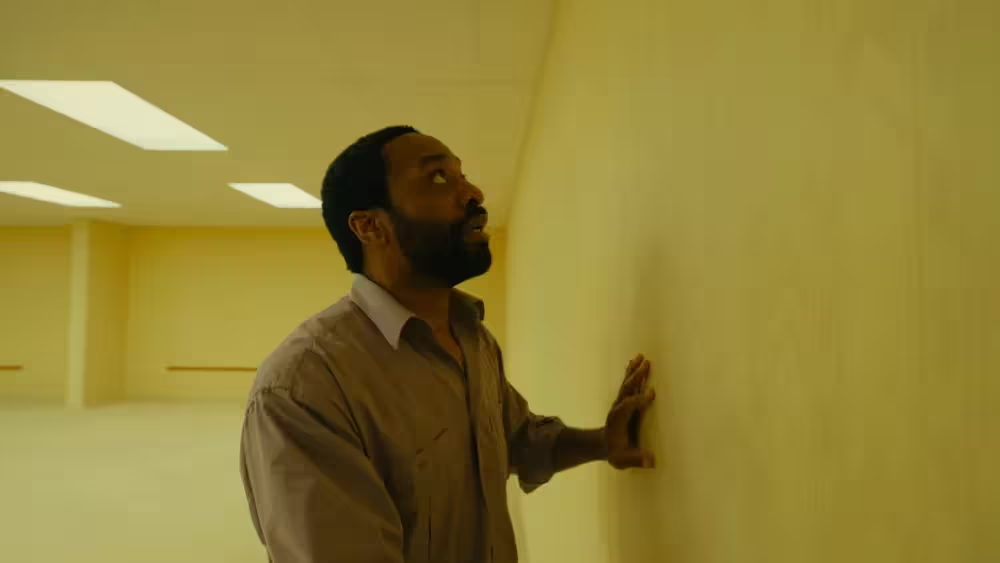
Parsons does his part. With a similar setting (kudos to the production design) the unsettling atmosphere comes almost naturally, and the director effectively captures this unease, particularly through wide, sweeping shots, using contrast to amplify the nauseating nature of these claustrophobic rooms as much as possible, while occasionally evoking the “found footage” style characteristic of his YouTube videos, which were made to look as if shot with old digital cameras.
The disorienting barrage, however, eventually loses its power when the narrative framework is forced onto the story. There isn’t much room for imagination regarding why these two professions—architect and psychologist—were chosen for the protagonists, around whom Will Soodik’s screenplay constructs a metaphorical framework that is, it must be said, rather exposed, almost affected.
Are the backroom floors the floors of the psyche, the subconscious into which we must plunge to confront the distortions generated by the clash between who we are and how we imagine ourselves? It takes no genius to figure out where the film is heading, where the aesthetic monotony of this place translates into an exasperating ordinariness that assaults reason, disintegrating it the moment the risks of blind adherence to a pre-established existence (study, find a secure job, settle down for life) explode the instant their failure becomes apparent.
The “noclip”—a gaming term referring to stepping outside the game’s boundaries due to glitches or bugs not anticipated by the developers—in Clark and Mary becomes a symbol of a mental and late-capitalist derailment lacking any real spark, leaving the film in a middle ground. The existence of this otherworldly place isn’t truly contextualized—as it should be—yet it’s assigned a very clear metaphorical motivation. Thus, it deprives us of the chance to fully experience the thrill that springs from the unpredictability of aimless trajectories, while simultaneously offering—or rather, imposing—an interpretation of events that’s too obvious, sketchy, and not entirely satisfying.
Nothing more and nothing less than the consequence of the transfer to Hollywood (the rampant production and distribution company A24) of a strong and already solidified imagery, extracted at no cost from its original context (and here one might argue at this point whether the container, the internet, constitutes a large part of the substance) and effectively standardized for a taste—the cinematic one—that calls for clearer, more precise, narratively traceable definitions.
Where the mystery that hangs in the air—including the presence of A-Sync, a company featured in Parsons’ videos that is somehow linked to the existence of the backrooms—serves no other purpose than to leave the door wide open, perhaps a bit too blatantly, to the possibility of a future series spin-off. The concept is powerful and uniquely compelling, but the film’s specific merit is rather limited.
